

If you’ve picked up Deborah Ellis’s The Breadwinner for your middle school classroom, you’ve already made a great choice. This powerful, compact novel follows Parvana, an 11-year-old Afghan girl who disguises herself as a boy to support her family under Taliban rule — and it never lets go of the reader. But teaching it well? That takes planning, the right questions, and a clear sense of what your students are ready to handle.
This post covers everything a middle school English teacher needs to feel confident walking into that first lesson: the big themes, the tricky parts, the best discussion questions, and the character work that makes this book come alive for 6th, 7th, and 8th graders.
The Questions Every Teacher Asks Before Starting This Novel
If you’re planning a Breadwinner unit, chances are you’ve already Googled some version of these:
“Is The Breadwinner appropriate for 6th graders?” Generally yes, with preparation. The book doesn’t contain graphic violence, but it does portray a regime that imprisons and beats people, and children who face starvation and loss. Pre-teaching the historical context of Taliban-controlled Afghanistan helps students process the story as a real-world event. Most 6th graders handle it well when the teacher frames it thoughtfully.
“What do I need to know about Afghan culture before teaching this?” You don’t need to be an expert, but a brief grounding in Islamic traditions, the history of the Taliban’s rise to power in Afghanistan in the 1990s, and the role of women under that regime will help your students understand Parvana’s world. Building this background before or during Chapter 1 prevents confusion and prevents students from drawing surface-level conclusions about religion or culture.
“How do I handle the sensitive content?” The novel’s most difficult content — oppression, poverty, the threat of violence, and grief — is presented with restraint by Ellis. It’s heavy, but not gratuitous. The best approach is to normalize conversation: let students name what they find hard, and redirect toward Parvana’s choices rather than the Taliban’s cruelty. What does she do? What does she decide? That’s where the power is.
“What are the best discussion questions for this book?” Keep reading — that’s exactly what the next section covers.
Discussion Questions That Generate Real Thinking
The biggest mistake teachers make with this novel is asking questions that have obvious answers. “Is Parvana brave?” leads to a one-word response. Here’s how to push deeper.
Before Reading / Activating Schema
- What do you already know about life in Afghanistan? What do you think you know that might not be accurate?
- If a law were passed tomorrow saying you couldn’t go to school, what would you do? What could you do?
- Who in your life would you risk something for? What would you be willing to risk?
During Reading — Comprehension + Analysis
- Chapter 1–3: Parvana’s family is educated, urban, and middle-class. How does Ellis use this detail to challenge stereotypes? Why do you think she made this choice?
- Chapter 4–6: Parvana resists disguising herself as a boy at first. What are her fears, and how are those fears different from her mother’s fears for her? Whose fear do you think is more reasonable?
- Chapter 7–9: How does Parvana’s relationship with Shauzia reflect the difference between surviving and living? What do they each want beyond survival?
- Chapter 10–12: Parvana tells stories to her little brother Zakia. What function do the stories serve in the novel? How does storytelling connect to identity?
Post-Reading — Synthesis and Argument
- Ellis has said she wrote this book so Western children would know Afghan children exist. Did the novel change how you think about a group of people or a part of the world? How?
- Parvana’s mother spends much of the novel paralyzed by grief. Is she a weak character, a realistic one, or both? Defend your position.
- By the end of the novel, Parvana has lost a great deal — but what has she gained? Is this a hopeful ending?
- If you were a human rights organization deciding which story to tell the world — Parvana’s, Shauzia’s, or the mother’s — which would you choose and why?
Character Study: Getting Beyond Surface-Level Analysis
Character work is where The Breadwinner really shines — and where many students get stuck at the surface.
Here’s a breakdown of the major characters and the teaching questions that unlock each one:
Parvana
She is the engine of the novel. Students who say she’s simply “brave” are missing the texture. Parvana is scared, resentful, grieving, and practical all at once. The key teaching question: What does Parvana want vs. what does she need vs. what does she do? That triangle — desire, need, action — is the heart of character analysis.
Push students to track moments when Parvana doubts herself. Where does her courage actually come from? Is it internal, or is it activated by necessity? There’s no single right answer — and that’s exactly what makes it great for writing.
Mother She is frequently misread by students as passive or weak. But Fattema is a woman who ran a household, supported her husband’s work, and raised children in a country at war — and then watched everything she built get stripped away overnight. Her paralysis is grief, not weakness.A strong character study question: At what point in the novel does Fattema begin to act again, and what causes the shift? This question requires close reading and rewards students who’ve been paying attention.FatherHe appears briefly but casts a long shadow. He is educated, gentle, and fiercely loving — a deliberate counter-portrait to the Taliban soldiers who arrest him. Students often want to know: Why is the father arrested? The answer (he is educated, he owned books, he challenged the regime’s narrative) opens up rich conversations about why authoritarian governments target teachers and intellectuals.ShauziaShe is Parvana’s foil and one of the most underanalyzed characters in the book. Where Parvana is tethered to family, Shauzia’s dream is to run. She wants to go to France and start over. Is that selfish? Is it survival? Is it just being 12?The best character work with Shauzia explores: What does it mean to belong to a family vs. belong to yourself?Mrs. WeeraShe is the practical adult who gets things moving again. Her character rewards a close look at how she speaks — she’s matter-of-fact, forward-looking, and refuses pity. Ask students: What would the novel look like without Mrs. Weera? What role do people like her play in real communities facing crisis?
How to Pair The Breadwinner with Nonfiction
Pairing the novel with informational text deepens comprehension and meets ELA standards for text-based analysis. Strong pairing options include:
- News articles about Afghanistan and the Taliban (historic and contemporary — there’s no shortage, and the contrast between 1996 and 2021 generates powerful discussion)
- First-person accounts from Afghan women — organizations like RAWA (Revolutionary Association of the Women of Afghanistan) have published testimony that contextualizes Parvana’s world
- The UN Convention on the Rights of the Child — a short excerpt makes a powerful anchor for a writing prompt: which of Parvana’s rights are being violated?
- Deborah Ellis interviews — Ellis has spoken extensively about why she wrote the book and the refugee children she interviewed. These make excellent pre- or post-reading texts.
- Here is a Deborah Ellis interview that I have used in my lessons with my students. Watch up to minute 08:37 and ask the following three questions –
- Name three countries that Deborah Ellis writes about.
- Why did Deborah Ellis decide to write book about children in these countries?
- How has working with children of these countries changed Deborah Ellis’s life? What emotions does she use to describe her experience?
- Here is a Deborah Ellis interview that I have used in my lessons with my students. Watch up to minute 08:37 and ask the following three questions –
Ready-Made Resources: Novel Study Questions + Character Study Guides
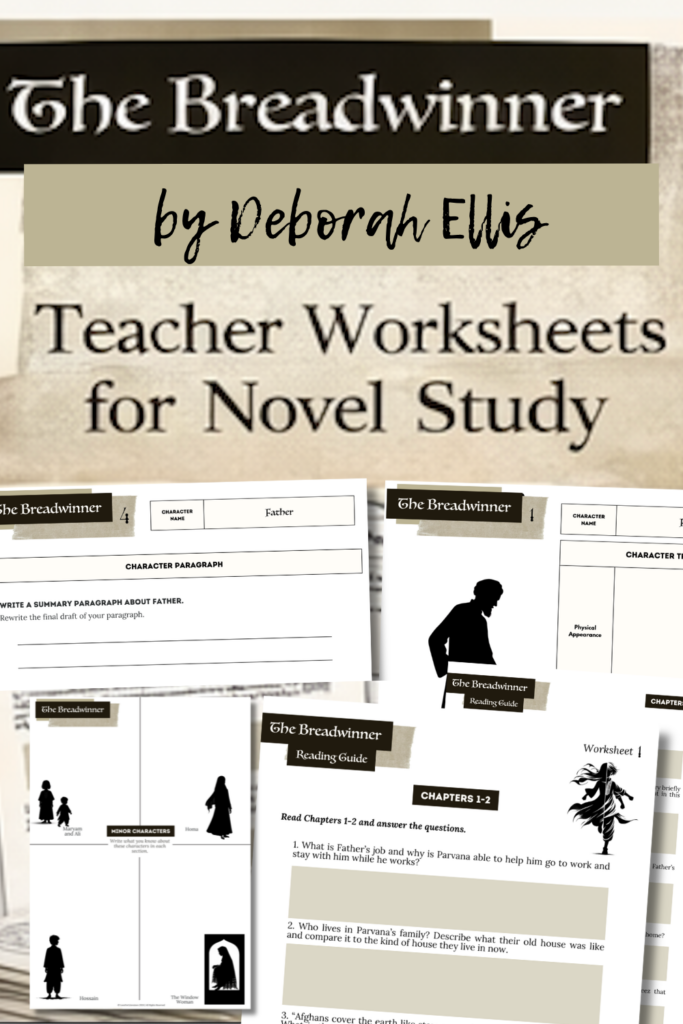
If you’re looking for a comprehensive set of ready-to-use materials — discussion questions by chapter, character analysis graphic organizers, vocabulary work, and essay prompts — I’ve put together a complete Breadwinner Novel Study and Character Study resource designed specifically for middle school classrooms.
These materials are built around the same principles in this post: questions that push beyond the surface, character work that respects the complexity Ellis built into the novel, and activities that connect the book to students’ own thinking.
What’s included:
- Chapter-by-chapter comprehension and analysis questions (all levels — recall, inference, and synthesis)
- Character study guide for all five major characters, with graphic organizers
- Thematic essay prompts with scaffolded planning pages
- Vocabulary in context activities
These are the exact materials I wished I’d had the first time I taught this novel — questions that generated real debate, character guides that helped reluctant analysts find their footing, and essay prompts that gave students something to actually argue about.
Final Thoughts: Why This Book Is Worth the Effort
The Breadwinner asks something of its readers. It asks them to sit inside a life that looks almost nothing like their own, to resist easy judgments, and to recognize courage in a form that doesn’t come with a cape or a victory speech.
That’s exactly what middle school literature should do.
If you’re starting this unit for the first time, trust the book. Trust your students. And build in time for silence — there will be moments in this novel when the class just goes quiet, and that silence is doing real work.
Good luck, and feel free to reach out with questions.
Looking for more middle school ELA resources? Browse the full collection here: [link]
Tags: teaching The Breadwinner, The Breadwinner novel study, middle school ELA, 6th grade novel unit, 7th grade novel study, Deborah Ellis classroom resources, The Breadwinner discussion questions, The Breadwinner character analysis, teaching Afghan literature
