
How I Would Tell You to Annotate The Odyssey (If I Were Your Classics Teacher)
 Sara · November 17, 2026
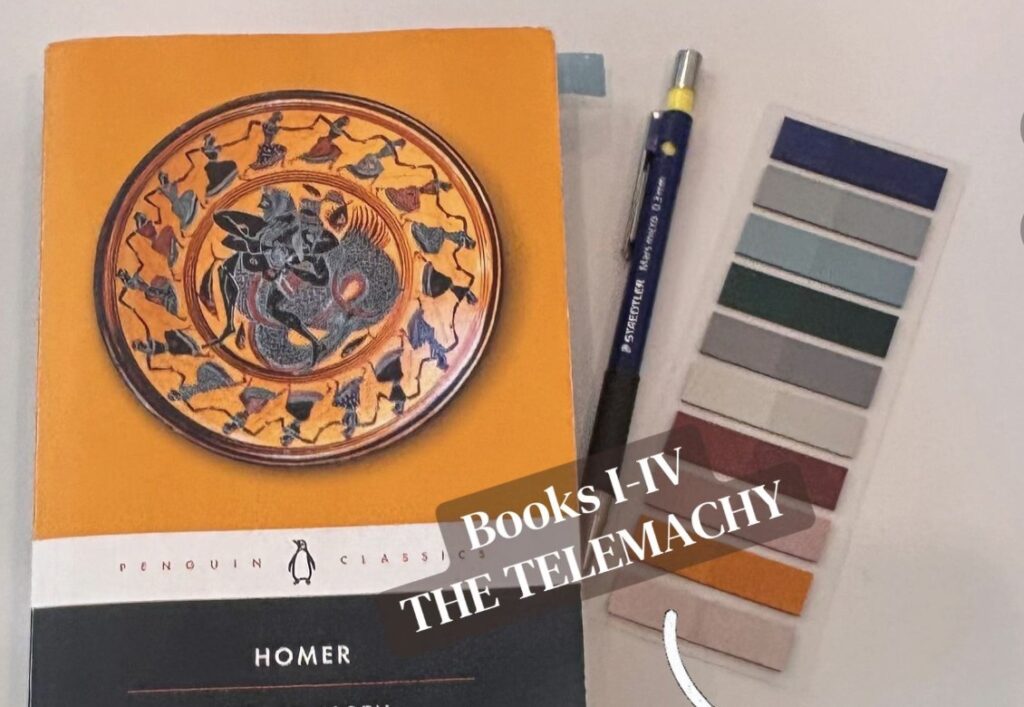
Annotating a classic is the best way to read it slowly enough to really let it sink in. You don’t need much: your copy of The Odyssey, a pencil, and four highlighters or sticky tabs in different colors. Each color tracks one thread through the first four books, so by the end of Book 4 you’ll be able to see the story’s structure at a glance, just by flipping through your pages. 🙂
The first four books are called the Telemachy: the story introduces us to Odysseus through the story of his son first of all. Telemachus is a young man who has grown up without a father, in a house full of suitors cheating and scheming against him to steal his inheritance while occupying his father’s quarters.
This is how I would suggest you annotate this part of The Odyssey.
The Odyssey · Books I–IV
Grab four highlighters or sticky tabs. Tap a tab to see what it tracks, then read with your own book open beside you.
Keep it in your photos or as your lock screen while you read.
Color 1: Athena’s point of view
Start with the gods. In Book 1, Athena pleads with Zeus on Odysseus’s behalf. Her heart breaks for him, stranded far from home on Calypso’s island. Highlight every moment we see through Athena’s eyes: what she notices, what she plans, and what she feels.
→ Why? Athena’s love for Odysseus is the only reason he gets home. His whole journey would never have happened without her.
She’s also loving towards Telemachus, and you’ll see that she hates that he doesn’t believe in himself. When he complains that the suitors will grind him down too, she breaks out in indignation: “Shameful!” She wants him to succeed, and her frustration is directed towards the injustice of his situation; his passivity hurts her as much as it does him! This is what I underlined in my pages. :)
Color 2: Telemachus’s fears and emotions
Now follow Telemachus. When we first meet him, he’s sitting among the suitors, daydreaming about his father dropping from the clouds and driving them all out. Then he notices a stranger standing at the door (Athena in disguise) and he’s mortified that a guest has been left waiting. Homer is showing us that Telemachus already has the qualities of a hero, and the first one we see is hospitality. Despite his insecurities, there’s an understated, quiet maturity.
Things I loved about Telemachus that moved me while reading:
- Any scraps of information about his father awaken the hope that he might still be alive.
- He sees the evil around him but can’t act on his desires yet. He has no strength or energy for vengeance or self-vindication … yet.
- His condition is complex because he is suspended between an unclear past and a dangerous present and future.
Color 3: Telemachus’s transformation
This is the color that shows the growth. In Book 4, in Sparta, Telemachus hears Menelaus speak of Odysseus and he weeps. Menelaus recognizes him at once as his father’s son. Highlight the moments where Telemachus is seen, recognized and affirmed.
The Telemachy is a mini-Odyssey about how Athena helps Telemachus. And a good question to ask here is:
What does it take for someone to start believing in themselves again?
Telemachus is validated, heard and loved until he is confident enough to trust himself. This is moving to read, and underlining these passages helps you see it happen over the course of the four books.
Color 4: Xenia (hospitality)
The last color is for xenia, the Greek sacred law of hospitality: how hosts welcome strangers, and how guests behave. It’s everywhere in the Telemachy: in Ithaca, where the suitors abuse it; at Nestor’s palace in Pylos (Book 3); and with Menelaus and Helen in Sparta (Book 4).
As you highlight, I would ask you these two questions:
- How does this theme propel Telemachus’s transformation?
- And how does it contribute to his mission?
Over to you
Are you reading The Odyssey right now? Which color did you end up using the most? Let me know in the comments. And if you annotate along with this guide, I’d love to see your pages if you’re willing to share: tag me on TikTok @sara_sorensen! :)
See the carousel on TikTok: @sara_sorensen
New to the classics? Download my free guide, How to read a classic, and find The Odyssey blog posts and resources in my Browse the Classics Library.
Compare and Contrast Graphic Organizers for literature, movies, podcasts and art: the comparative method, ready for your next lesson.
Download here