October is one of my favorite times to bring creativity into the classroom.
The crisp air, pumpkins on doorsteps and playful spookiness create the perfect atmosphere for storytelling.
Creative writing is a skill students learn through doing. When we value creative expression, celebrate original thinking and give students a framework to engage their creativity regularly, students grow as writers and thinkers. And Halloween is a great time to practice descriptive skills!
If you want to make the most of the Halloween season and develop your students’ writing skills, keep reading!
Halloween Writing Prompts for Dwindling Attention Spans
Let’s be honest: October is when attention spans often start to wander.
Because the excitement of costumes, candy and fall activities is everywhere, students need activities that keep them engaged and concentrated.
Writing-to-learn quick writes can be very helpful to prevent students’ attention spans from wandering. Writing, being a manual task, helps them process their thoughts and focus their energy on a single task.
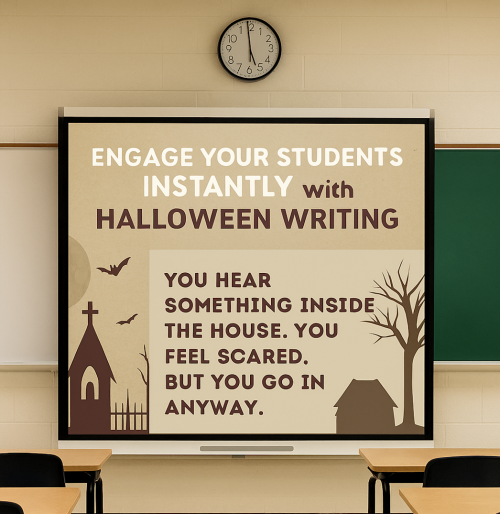
The Halloween writing prompts are great as a once-off activity but can be best used as part of a daily lesson routine as a bell-ringer or exit ticket activity.
In no time at all, your students will be crafting “silly spooky stories” with rich, sensory language that strengthens vocabulary and narrative technique!
How to Teach “Show, Don’t Tell” Using Halloween Writing Prompts
In her address to novel writers in The Value of “Show, Don’t Tell”[Writer’s Digest], Jessica Bell writes about the importance of letting readers experience a story rather than simply hear about it.
When students learn to describe how a character’s “face turned red” instead of writing “she was angry,” they begin to grasp how emotion lives in detail, not in summary.
Halloween writing prompts can help students practice this skill through eerie and suspenseful scenarios.
Halloween Writing Prompts as Tools (Not Rules) for Better Writing
As we know, great writing grows from having the right tools, not rigid rules.
As Stephen King says, every writer must “construct [their] own toolbox and then build up enough muscle so [they] can carry it with [them]. Then, instead of looking at a hard job and getting discouraged, you will perhaps seize the correct tool and get immediately to work.” (Notes from Stephen King’s “On Writing”, 2000).
Regular targeted practice builds muscle memory until your students start using these strategies consciously and unconsciously in every writing assignment.
Halloween writing prompts can be short and focused and invite students to experiment with vivid verbs, precise imagery, and multi-sensory language until those habits feel natural.
What’s Inside the Halloween Descriptive Writing Unit
Watch this preview video for a full overview of the what the bundle contains.
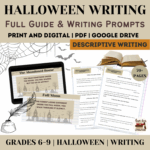
This resource package gives you everything you need to implement descriptive writing during Halloween.
It is a done-for-you digital resource.
Here’s what you’ll find:
Teacher Guide – Step-by-step lesson tips, along with answer keys.
Student Guide (PDF + Google Drive) – A clear breakdown of “Show, Don’t Tell” with examples.
50+ Halloween-Themed Writing Prompts – Perfect as bell ringers, quick writes, or exit tickets.
Practice Worksheets – Including a Show/Don’t Tell transformation table and word bank activities.
Answer Keys – Designed to make grading much easier.
Vocabulary Word Bank Builder – A pre-writing tool that helps students collect sensory words before diving into prompts.
As a result, both you and your students have everything needed for successful writing practice.
How You Can Use It in Your Classroom
When I designed this unit, I wanted it to be as flexible as possible. Therefore, you can adapt it for different lesson goals and classroom needs.
Here are some ways you can use it:
Bell Ringers & Quick Writes – Start class with a spooky spark of creativity.
Exit Tickets – Reinforce learning with short descriptive check-ins.
Vocabulary Builders – Expand sensory language before students write.
Because it’s flexible, comprehensive, and student-friendly, your October lesson planning becomes so much easier.
It blends the fun of Halloween with a structured and rigorous approach, so that your students can strengthen their writing skills and have fun along the way!





 Previous Post
 Next Post