

Teaching Oedipus Rex can feel like a heroic act in itself. The language is dense, the themes are heavy, and the chorus alone is enough to make even the most engaged student whisper, “Wait… what’s happening?”
Yet year after year, Oedipus Rex becomes one of my students’ favorite units — and there’s a reason for that. When we teach classical texts with context, clarity, and strong scaffolding, students finally see why stories like this one have shaped the Western literary tradition for thousands of years.
In fact, organizations like the National Endowment for the Humanities emphasize that engaging students with classical literature builds critical thinking and cultural literacy (NEH article on teaching ancient Greek). And when students learn how to read ancient texts actively — looking for clues, patterns, characterization, and themes — they’re doing much more than simple reading comprehension. They’re learning foundational skills for analytical thinking, argumentation, and close reading.
There’s also strong evidence that narrative structure improves comprehension. According to Harvard Business Review, information becomes dramatically more memorable when embedded in a story (Why Your Brain Loves Good Storytelling). Similarly, Harvard Business Publishing explains that storytelling enhances learning because it engages emotion, structure, and pattern recognition (What Makes Storytelling So Effective for Learning). Oedipus Rex, with its detective-story pacing, emotional intensity, and powerful dramatic irony, does all three brilliantly.
However, none of this happens automatically.
Students need the right structure, the right explanations, and the right opportunities to grapple with big ideas like fate, free will, justice, truth, and identity. Without scaffolding, it’s easy for them to get lost in the language or frustrated by the chorus.
That’s exactly why I created my Oedipus Rex Unit Bundle — a comprehensive, ready-to-use study guide, lecture slide deck and answer key designed to make this play not only accessible but thrilling for high school students. My goal is to give teachers a meaningful, practical way to introduce students to Greek tragedy, while also honoring the wisdom and dramatic brilliance Sophocles wrote into every scene.
Below, I’ll walk you through the biggest challenges students face with this text — and how this unit removes those barriers so your class can fully connect with the emotional and philosophical depth of Oedipus Rex.
1. Students Don’t “Get” Greek Tragedy at First
Greek tragedy can feel distant and abstract if students jump straight into reading. They see masks, references to Apollo, sweeping stasimons, and they immediately think it’s irrelevant.
So, I always start with context.
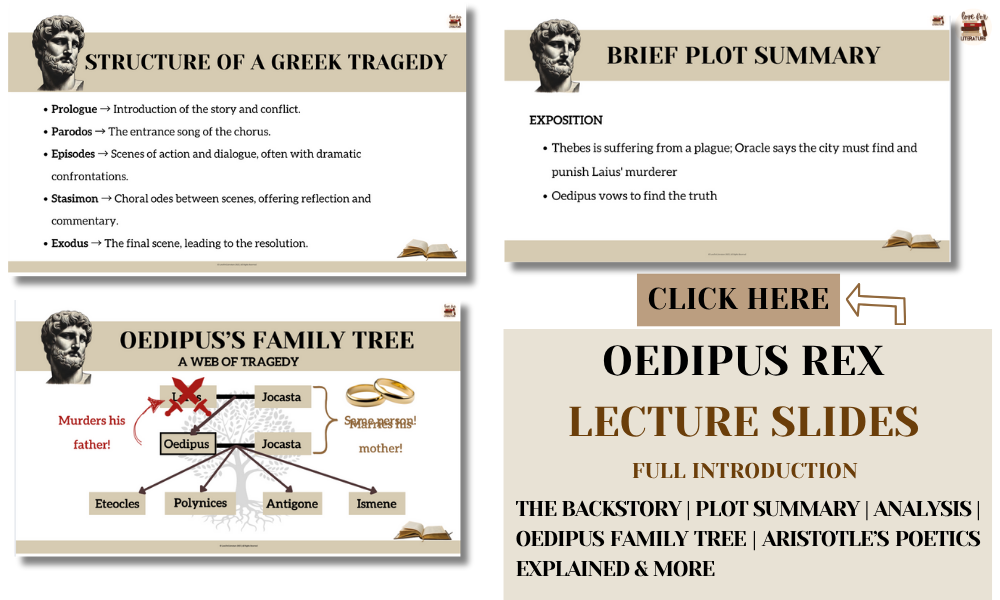
My lecture slides introduce:
ancient Athenian theater
the role of the chorus
why tragedy mattered
how citizens viewed fate, justice, and prophecy
This way, by the time they meet Oedipus, they’re ready to understand the stakes.
And yes — this is where the Oedipus Rex Unit Bundle saves you hours.
The slides explain everything clearly so students actually want to read the play.
2. The Language Feels Intimidating
Sophocles’ syntax can be complex, and students often shut down when they hit a confusing line. Instead of pushing through, they freeze.
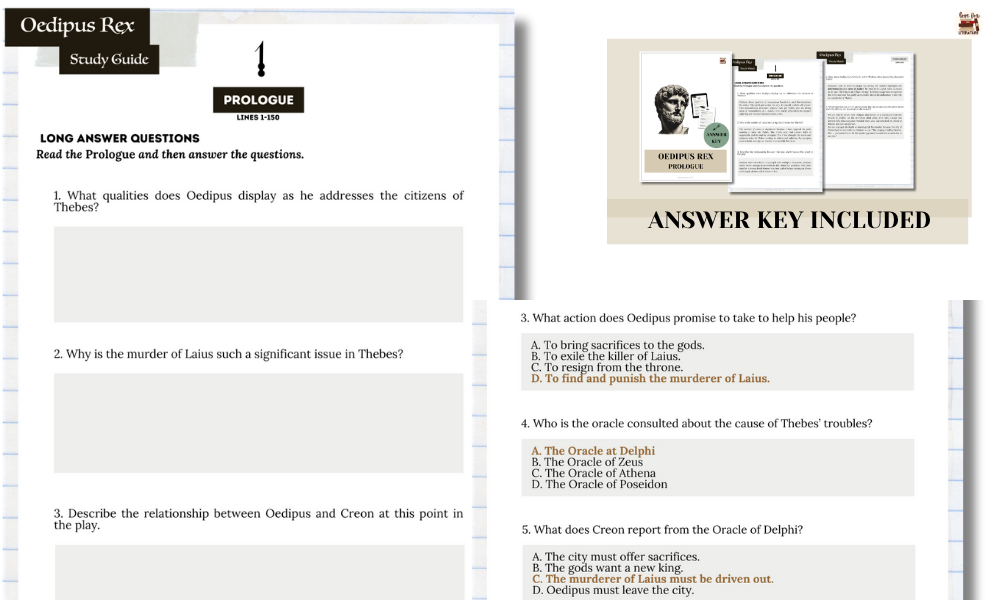
Because of this, I use my episode-by-episode study guide to break the text into manageable pieces. Students answer a mixture of comprehension questions, long-response thinking prompts and irony-tracking tasks. As a result, they build confidence as they go.
These questions can be assigned as homework, done individually in class or as a group.
It’s incredibly satisfying to watch students go from “I don’t get it” to “Let me explain what Sophocles is doing here…”
3. Aristotle’s Poetics Feels Abstract (Until It Doesn’t)
Peripeteia, anagnorisis, catharsis — students can memorize the terms, but they rarely feel them.
So, I present these terms at the beginning of the unit. Then, the study guide helps them recognise the concepts in context, as they’re reading.
Inside the lecture slides, I walk through some of these high-level key concepts:
reversal
recognition
catharsis – pity and terror
- how art humanized the masses and Greek tragedy as a form of civic education
Embedding this college-level theory in the reading guide little by little as they engage with the story helps them grasp it much easier and in a really natural way!
4. Students Miss the Dramatic Irony Completely
When we go through the plot summary in the lecture slides, before we start reading, students always wonder: “How does Oedipus NOT know it’s him?”
I never spoil the ‘how’ to my students! I love seeing them put the pieces together as we read.
Dramatic irony is the first source of intrigue before we read— but the study guide prompts students to track the clues, contradictions and warnings in each episode. This means they read actively, not passively. They begin predicting, connecting, and arguing their interpretations.
This is also an opportunity for really interesting class discussion and getting students to offer their predictions on how the murder mystery unfolds…
5. The Chorus Confuses Everyone
As I think most teachers will agree, the chorus and the odes/ stasima are the biggest barrier for students! When I started teaching Oedipus Rex, I used to just read the odes, without even commenting on them.
At some point, I made the effort to create some questions that would help us avoid “skimming” this part of the play with
- three multiple choice questions
- five long questions.
After all the chorus are narrators, philosophers, commentators and “background singers” all in one. My goal wasn’t for them to understand all the lyrical poetry, but that they experience and appreciate the tone and feeling of the odes.
The questions break down:
what the chorus is
what they actually do
how each stasimon reacts to the action
tone, characterization and commentary of the plot
Truthfully, what I think matters most is when students grasp how the chorus added to the drama and its contribution to “catharsis” (the emotional experience). Analysis is secondary in my opinion!
6. Students Don’t Understand Oedipus’s Character
High schoolers sometimes see Oedipus as overly emotional or irrational.
When they learn about honor culture, prophecy and Athenian leadership, everything clicks. The slides and the study guide questions help them see Oedipus not as a hothead but as a noble, complex figure.
The tragic irony lies in the fact that Oedipus’s desire for truth, the most noble of his qualities, coincides with his downfall. Pointing out his “heroic” traits is important to grasp the full extent of terror and pity in the story.
7. Students Struggle to Keep the Plot Straight
Between prophecies, plague, past events, shifting identities, and multiple messengers, the plot can feel overwhelming. The timeline gets confusing fast! Students mix up who knows what at which point and lose track of the emotional stakes.
The structured questions in the study guide keep the reading grounded. Students track events, clues, clues, and revelations in a clear sequence, which helps them follow the story with confidence and insight.
8. Teachers Lose Hours Prepping Everything
Prepping a unit like Oedipus Rex from scratch requires:
context slides
reading questions
Aristotle explanations
comprehension checks
theme and irony tracking
The Oedipus Rex Unit Bundle removes that burden so you can spend your time engaging with students, not creating materials.
6. Students Don’t Feel Catharsis — They Just Define It
Catharsis should be experienced, not memorized as a definition.
The episode and stasimon questions guide students emotionally through pity, fear, and recognition. Their final reflections are always richer and more insightful because they’ve lived the experience, not just studied it.
When they write about catharsis at the end, the answers are always richer, more personal, and more emotionally intelligent than expected.
Conclusion
This resource helps students meet the play with clarity and maturity. It gives them the context they need, breaks the text into manageable parts, and encourages them to think deeply about justice, identity, truth, and fate. And because the resource breaks the text down into clean, digestible stages, students stay engaged from the first oracle to the final stasimon.
Most importantly, though, I wanted a resource that helps students encounter the wisdom of the classics — not just pass a quiz! I want them to truly appreciate why Oedipus Rex still matters after two thousand years. If they finish the unit feeling changed, thoughtful and more aware of the human questions Sophocles raises, then I consider my job more than done!
If you want your students to love this play as much as mine do, you can find the full bundle here:
👉 Oedipus Rex Unit Bundle (Study Guide + Lecture Slides + Answer Key)
